
Features
X-Hunt: A Sci-Fi Browser MMO Fully Playable by Blind Players

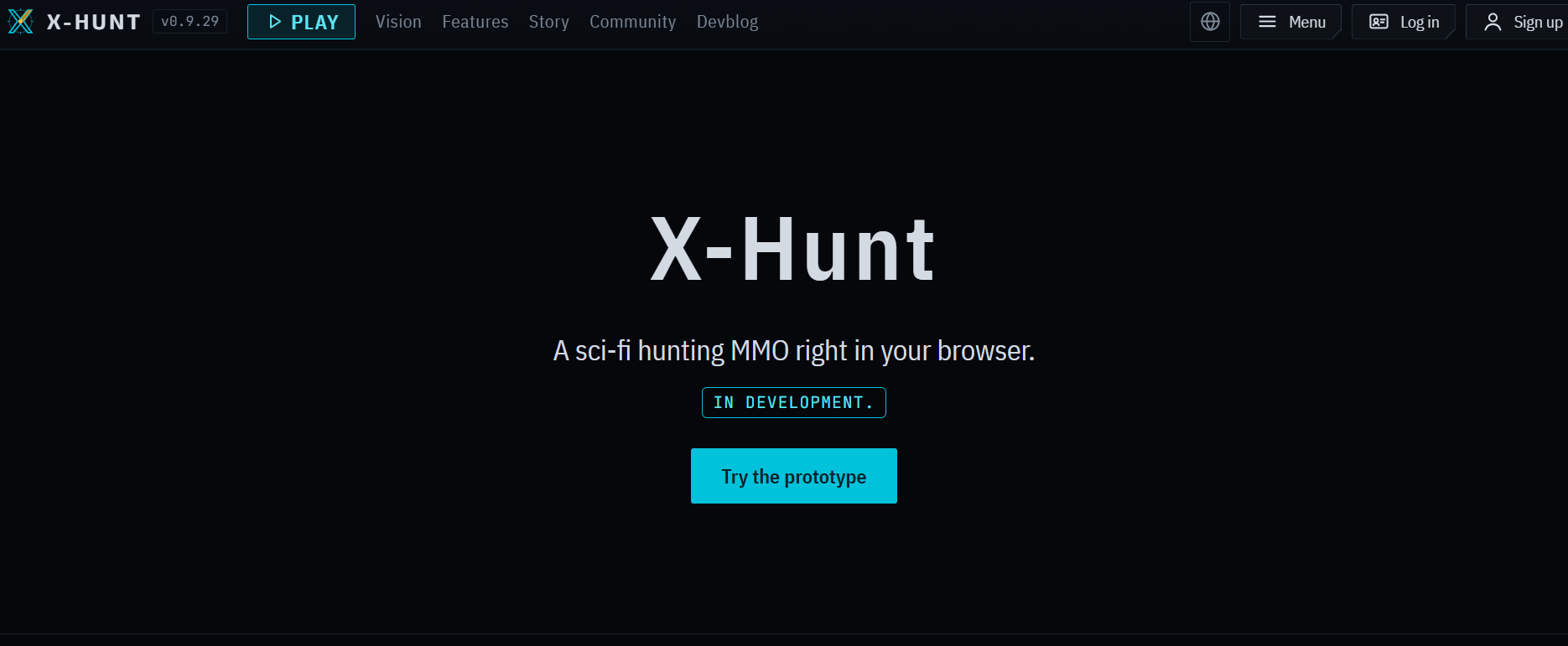
X-Hunt is a science-fiction hunting MMO that runs in a web browser. The game is in pre-alpha and is preparing for release, and its prototype is open to anyone who signs up. It has a persistent world and a player-driven economy, and it is designed to be fully playable by blind and visually impaired players through a separate client built for screen readers.
A game made for players with little time
X-Hunt is the project of Dan, who has spent his career in online game publishing and marketing. In the game’s devblog he writes that he has played online games since 2002 and that EVE Online and Entropia Universe, both discovered in 2003, shaped how he sees the genre. He describes X-Hunt as his vision of a modern MMORPG for players aged 35 and over.
His reasons are set out in the same post. A couple of hours in the evening is not enough to keep up with a modern online game, and existing semi-automated games tended to fall into two extremes, with automation either a limited add-on or the whole game built around timers. Bright 3D graphics, he adds, had also become tiring for his eyes. X-Hunt is his attempt to combine the features he could not find in one place.
The world: colonists, the Arc and ECHO
The game’s story begins with a colonist waking from hibernation. The first chapter, published on the official site, is narrated by ECHO, the wake-up protocol of a landing module and a small part of a larger ship intelligence that the colonists call the Arc. Humanity once built three Arc-class ships, each a city, factory and laboratory in a single hull, and each with its own priority.
Players move between sectors of an alien planet through a network of beacons and teleport routes. The design principles say the world should be explored and should keep its mysteries. The setting is also meant to give a logical, in-world explanation for the game’s conventions.
Hunting, gear and a player-driven economy
Hunting is the core activity at this stage. A hunt starts at a station, continues in a combat sector, and ends back at the station with repairs, storage and trade. Weapons wear with every attack and gear needs repair.
The economy is player-driven. Under the game’s stated principles, players create most items themselves, the model is based on scarcity with no endless inflation, and NPCs follow the same rules as players. The developers describe it as a realistic economy that protects the value of the time and effort players put in over the long term. The same principles warn that careless play has consequences: players who neglect their gear and resources can go bankrupt in the game.
Hunting is one of several ways to take part in that economy. The pre-alpha already includes resource Extraction, a market, and a first version of Production. Production uses a shared library of blueprints and adds Research to improve a blueprint and Invention to discover new ones.
Players work out the formulas
The rules, the devblog says, are fair and identical for everyone, but the formulas are not posted on every corner: players are expected to collect data, study the mechanics and plan their own approach. The game also includes a hunting compendium. For crafting, the team has decided to show the odds of outcomes to the player, so Production can be planned with known chances.
Semi-automation as part of the design
Respect for the player’s time is another of the listed core principles. X-Hunt includes tools for legitimate semi-automation of key activities, and the developers write that automation is a natural part of the core systems and is not meant as a loophole for bots. In hunting, this takes the form of combat models: the player can choose a model that lets the character fight on its own, or switch to manual control.
The Invisible Client
Accessibility is one of the founding principles of X-Hunt. By the developers’ account, the game is accessible to visually impaired and blind players and can be fully played with a screen reader, including manual combat.
To make that possible, the team built the Invisible Client, a dedicated text-based version of the game for screen readers. It opens at its own address and connects to the same game, the same character and the same economy as the standard interface. Players can switch between the two views without reconnecting. According to the project’s documentation, the Invisible Client receives exactly the same game information as the visual client, and balance is not changed for either interface.
The Invisible Client is built as an ordinary, well-structured web page with headings, buttons and lists, so players can navigate it with the keys they already use. NVDA on Windows is the primary target screen reader. Combat happens in a separate keyboard area where game keys work only while focus is inside it. A text command line in the style of classic MUD games, opened with Ctrl+Enter, offers a second way to act and accepts commands in Russian, English and German. Directions can be announced as compass points or “by the clock” relative to where the character is facing.
The client has three sound schemes, and the full scheme adds tactical signals such as a swing in an area, a hit from behind, low health and a lost target. Every sound is duplicated as text, and all speech comes from the player’s own screen reader. An update in late November 2026 added a separate sound for the player’s own hits, distinct from incoming hits, and made health warnings at 50, 25 and 10 percent the default. The urgent warnings now also give the direction and distance to the sector’s beacon. A single Backspace key sends the character back to the beacon.
The team works with a blind tester who plays with NVDA and reviews new features, and many recent changes to the Invisible Client came from his reports. Under the team’s rules, every new mechanic must get its own section in the Invisible Client, and features such as Production and Extraction have already been added there.
Simple graphics by design
The graphics of the visual client are described in the devblog as simple and outline-based, with the remark that “the best graphics card is the player’s imagination”. Sectors can be viewed in several ways, and a tactical 3D view is now the default.
Pre-alpha status and roadmap
X-Hunt is in pre-alpha and received several updates a week in November 2026. The published roadmap and vision lays out the path toward alpha, beta and release. Next on the list are a full skill system, advanced monster behaviour, groundwork for group hunting, NPC corporations and city contracts. Later stages add player corporations, PvP and raids, and the longer-term plans include mechs and preparation for spaceship construction. The roadmap states that it will evolve together with the game and its community. The site is available in English, German and Russian, and the prototype can be played in the browser from the official site.



X-Hunt: A Sci-Fi Browser MMO Fully Playable by Blind Players

How to Stake on CS2: A Beginner’s Guide to Pro Matches

GTA 6 Infinite Money Glitch: How to Farm Cocaine Cash in Vice-Dale County

From a Single Block to a Whole Empire in Five Honest Steps

What Modern Games Can Learn from Indie Video Game Design

Steal a Brainrot Traits Guide: How to Get Them and Boost Your Income

FC 27 Coins: Best Wingers for Different Budgets

Tamon’s B-Side Season 2 Is Officially Confirmed! Here’s Everything We Know So Far

Best DNS Servers for Gaming in 2026: 6 Options for Speed and Stability

How to Grow a Gaming TikTok From Zero in 2026: 8 Steps

This New Fall Romance Anime Will Make You Fall in Love!

Level Up Your Audio: How to Score the Next Big Indie Game from Your Bedroom

Mr Villain’s Day Off Might Become Your Next Favourite Comfort Show! 🐼💕

Online games with cryptocurrencies — what does the gameplay look like?

Cat Girl, Fox Girl, Wolf Ears: Designing a Kemonomimi Character

The Perfect Season to Rewatch Laid-Back Camp (Yuru Camp) Is Finally Here! 🍂🏕️
-
 Technology4 weeks ago
Best DNS Servers for Gaming in 2026: 6 Options for Speed and Stability
-
 Social Media4 weeks ago
How to Grow a Gaming TikTok From Zero in 2026: 8 Steps
-
 Anime4 weeks ago
This New Fall Romance Anime Will Make You Fall in Love!
-
 Technology4 weeks ago
Level Up Your Audio: How to Score the Next Big Indie Game from Your Bedroom
-
 Anime1 week ago
Mr Villain’s Day Off Might Become Your Next Favourite Comfort Show! 🐼💕
-
 Features3 weeks ago
Online games with cryptocurrencies — what does the gameplay look like?
-
 Anime3 weeks ago
Cat Girl, Fox Girl, Wolf Ears: Designing a Kemonomimi Character
-
 Anime2 weeks ago
The Perfect Season to Rewatch Laid-Back Camp (Yuru Camp) Is Finally Here! 🍂🏕️
-

 Features3 weeks ago
GTA 6 Might Be the Most Anticipated Game Ever… If Not, What Was?
-
 Features4 weeks ago
What It Takes to Stream One Game to Hundreds of Screens at Once
-

 Technology4 weeks ago
How Does AI Marketing Increase the Reach of Gaming Blogs?
-

 Features3 weeks ago
From The Price Is Right to Crypto Games